Commercial lease abstraction: what it is and how to get it done
A lease abstract is a one-page summary of a commercial lease's key business terms — so you can see rent, dates, escalations and options across a whole portfolio without re-reading hundred-page documents. Here is what abstraction involves, the realistic ways to get it done, and the one check that keeps the numbers trustworthy.
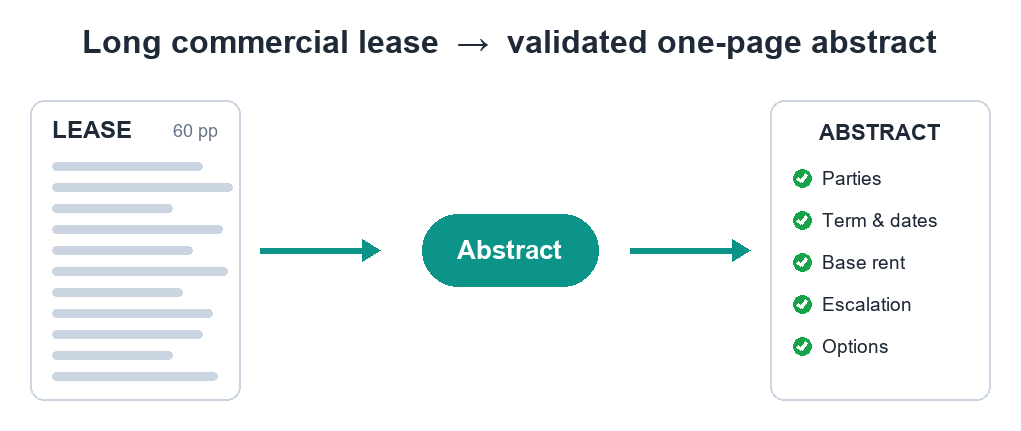
What a lease abstract actually is
A commercial lease can run 40–100+ pages of dense legal text. A lease abstract pulls the terms that actually drive decisions into a short structured record: landlord and tenant, the premises and square footage, commencement and expiration dates, base rent and how it escalates, renewal and termination options (and their notice deadlines), the security deposit, operating-expense (CAM/NNN) terms, permitted use and governing law. Once every lease in a portfolio is abstracted the same way, you can finally answer the questions that matter — which leases expire next year, what your rent escalations are, and where you hold options you must not miss.
The manual way (and why it doesn't scale)
Done by hand, an analyst spends 1–2+ hours per lease reading and keying the terms. For a handful of leases that is fine. For a portfolio of hundreds or thousands — or a due-diligence deadline on an acquisition — it is slow, expensive, and error-prone. And the errors are costly in a specific way: a misread base rent or a missed renewal-notice date doesn't surface until you overpay or blow past an option window.
The three ways to get it done
Manual / offshore abstraction — outsourced analysts at roughly $50–200 per lease. Flexible, but slow and only as consistent as the person doing it. Enterprise AI platforms — tools like Yardi's Smart Lease, MRI and Prophia are powerful, but they are bundled into full CRE platforms with subscriptions and implementation, aimed at larger operators already on that stack. Done-for-you AI abstraction — AI vision reads the lease, extracts the fields, and the numbers are validated, delivered per lease with no platform lock-in. This is the practical option for a smaller portfolio, a broker or law firm, or a one-off diligence batch.
The lease abstraction process, step by step
However you get it done, good lease abstraction follows the same steps:
- Collect the leases and any amendments, side letters and exhibits — the terms you need often live in the amendments, not the original.
- Define the abstract template — the exact fields to capture, so every lease is summarized the same way and stays comparable across the portfolio.
- Extract the terms — parties, dates, base rent and escalations, options and notice deadlines, deposit and CAM/NNN — by hand or with AI vision.
- Validate against the source — reconcile the numbers (monthly rent × 12 = annual) and flag ambiguous clauses or missing notice dates for a human to confirm.
- Load into a register — a spreadsheet or lease system where you can filter by expiration, rent or option date.
- Set date alerts — renewal and termination notice deadlines are the whole point; a missed one auto-renews or forfeits an option.
What a good abstract captures
A record you can actually rely on includes:
- Parties & premises — landlord, tenant, address, suite, rentable square feet.
- Term — commencement and expiration dates, and the term length.
- Rent — base rent (monthly and annual) and the escalation clause.
- Options — renewal and termination rights, with their notice deadlines.
- Money & costs — security deposit and operating-expense (CAM/NNN) terms.
- Use & law — permitted use, governing law, and whether it auto-renews.
The check that keeps the numbers right
This is the step that separates a reliable abstract from a risky one. Suppose a base rent of $8,854.17/month is misread as $8,584.17 — that quietly understates the annual figure by thousands across the record. A validation layer catches it because the numbers have to reconcile: monthly rent × 12 = annual rent ($8,854.17 × 12 = $106,250), and square footage × rate = annual rent ($25.00 × 4,250 sq ft = $106,250). The same discipline flags an ambiguous clause or a missing notice date for a human to confirm, instead of letting a confident misread flow into your portfolio.
Which approach fits you
A large operator already on a CRE platform — the enterprise tools bundled into that platform make sense. A smaller portfolio, a stack of leases from an acquisition, or a broker / law firm handling diligence — a done-for-you, per-lease abstraction service gets you a validated record without a platform commitment, and scales with the batch instead of a subscription. The common thread is the same as any document work: the value is only real if the extracted numbers are checked, not trusted.
Skip the manual work
DocAuto turns your invoices, receipts and bills into clean, validated spreadsheet data — every figure checked before you get it.
Send a document — free sample